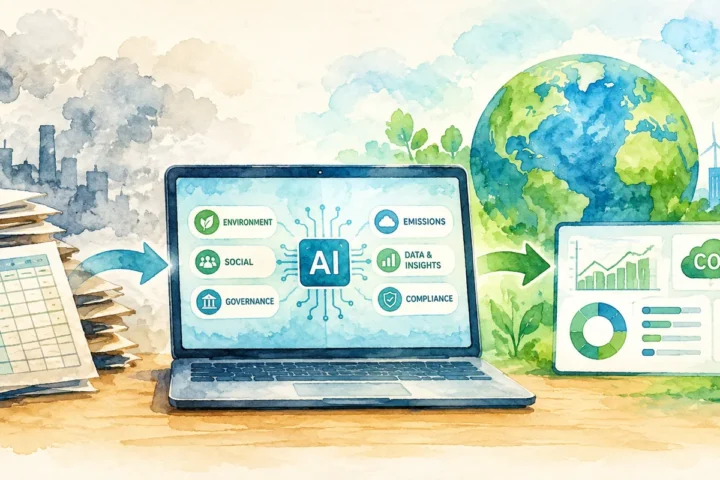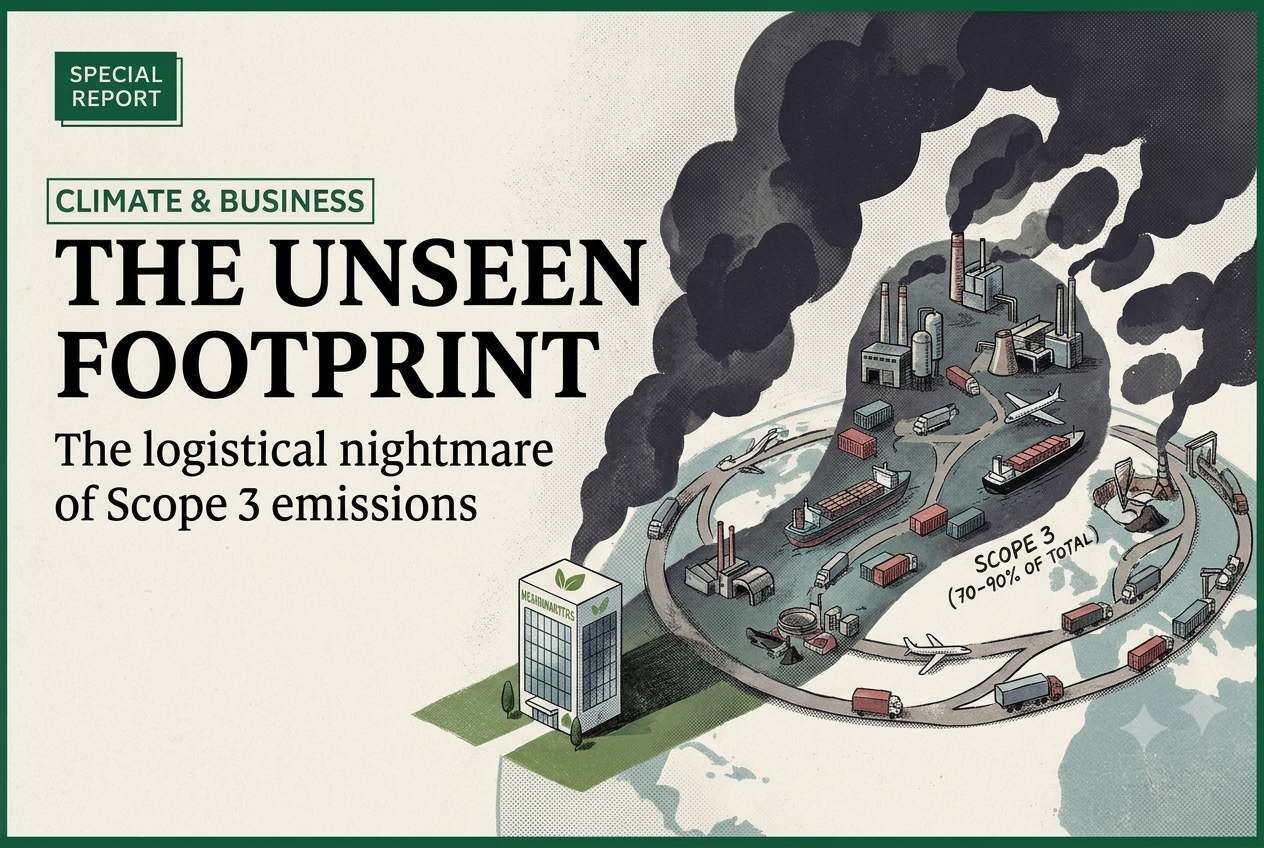
Beyond marketing claims and direct operations lies a company’s true climate impact. Because the vast majority of a business’s carbon footprint is hidden in deep layers of its supply chain, raw material extraction, from manufacturing to transportation, distribution and product use. Deploying AI for Scope 3 emissions is now critical to accurately measure and manage this complex network.
The universe also includes third-party logistics, global shipping networks, and customers’ end-to-end use of and disposing of the final product.
In fact, leading environmental and business research groups like CDP and McKinsey estimate that up to 90% of emissions typically fall under Scope 3. This encompasses everything from third-party vendor operations to downstream waste management.
| Sector | Largest Scope 3 Category | Average Share of Total Emissions |
|---|---|---|
| Financial Services | Various | Up to 99.98% |
| Capital Goods | Use of Sold Products | ~90% |
| Cement Industry | Various | ~16% |
| (Data sourced from CDP reporting) |
Data Table 1
Despite the immense weight of Scope 3 emissions, measuring them accurately remains a logistical nightmare. A March 2024 stakeholder survey published by the Greenhouse Gas (GHG) Protocol revealed that a lack of supplier-specific emissions data and paywalled life cycle inventory databases are major hurdles for market-wide adoption of Scope 3 accounting. Respondents noted severe challenges for both SMEs facing capacity constraints and large-cap companies dealing with massive supply-chain complexity.
Historically, measuring the massive outside network was difficult. They couldn’t or didn’t ask their suppliers for real data. So, reporting framework was weak and had loopholes. Organizations tried to solve this problem as if ideologically fighting against waste, inefficiency, volatility, and resource scarcity by using generic spend based proxies. Here is an example.
Let’s assume a company spent $1 million on fabric. The sustainability team would look at an industry average that said, “$1 million of fabric equals X amount of carbon.” Hence, instead of specific supplier data on coal, solar energy etc. the team can use a generic industry average. Also, teams many a times excluded smaller suppliers by using vague language to claim it was too hard to measure them.
How Regulatory Shifts are Closing the Loopholes
Such generic average laden reports don’t reflect the reality. Now, the major global rulebook for carbon accounting “the Greenhouse Gas (GHG) Protocol” is rolling out strict new updates in 2026.
The GHG Protocol’s 2026 Phase 1 Progress Update proposes strict new rules that will force companies to improve data quality and rely heavily on direct supplier engagement.
Proposed 2026 GHG Protocol Scope 3 Updates
Data table 2
AI native ESG platforms are bringing granular clarity to complex supply chains. They are pulling real-time data from enterprise procurement systems and replacing generic industry averages with verified, real-time data. In other words, AI-native ESG platforms are turning logistical nightmare of tracking thousands of third-party vendors into an automated, audit-ready data pipeline. Companies can now move away from low hanging spend based proxies and incline towards verifiable primary supplier data.
The play involves more than an automating a tedious reporting chore. AI for end-to-end supply chain visibility directly integrates with Factory 4.0 IIoT.
Modern AI platforms ingest real-time telemetry data from smart factory sensors, smart meters, and connected machinery to monitor precise energy consumption and operational metrics. Combined with this, verified supplier intensity data flows directly into Scope 3 calculations without manual entry.
Hitachi Rail, which successfully increased its Scope 3 coverage from 15% to 90% using automated carbon accounting solutions (link)
By taming layers of complex chaos of supply chain data, AI platforms are turning an overwhelming compliance hurdle into highly accurate carbon accounting, operational tracking and clean compliance.