After decades of being dominated by oil-rich petrostates, a UN climate summit finally appears ready to chart out a path for energy-consuming nations like India, to help them jettison their dependence on fossil fuels and transform into electrostates by 2035.
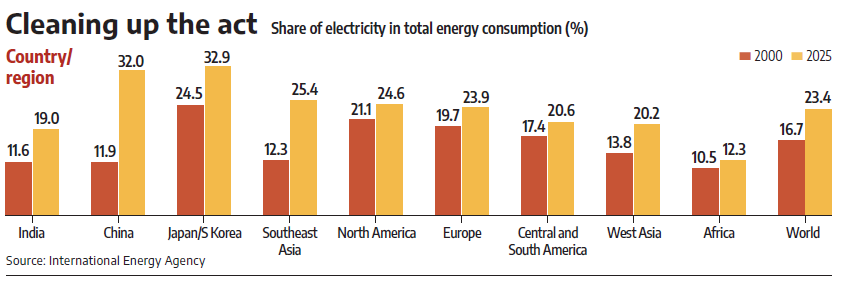
Until now, moves towards electrification have not been underpinned by a clear global goal at these summits, known as Conference of the Parties (COP). But this November, in the resort town of Antalya, Turkiye, both buyers and peddlers of fossil fuels will gather to take a “35-by-35” pledge — increase the share of electricity in the overall global energy mix to 35 per cent by 2035 from roughly 20-23 per cent now.
Murat Kurum, the Turkish president designate of the Antalya summit, the COP31, told industry newsletter Carbon Brief that the plan — prepared with the International Energy Agency (IEA) and International Renewable Energy Agency – keeps the 1.5-degree celsius planet warming target within reach and reflects science not politics. Moreover, it builds on the Dubai COP28 target to triple renewable capacity and double energy eiciency by 2030.
Kurum said the Brazilian and Ethiopian presidencies of COP30 and COP32, along with the European Union, UK and Canada, “have confirmed electrification will be central to discussions at COP31”, to be co-hosted by Turkiye and Australia.
“We are still in the middle of an energy crisis with crippling oil and gas prices and electrification is the key lever to change that,’’ said Jan Rosenow, professor of energy and climate policy at Oxford University.
“Most energy use can be electrified with existing technologies, and electric machines waste far less energy than the fossil systems they replace.’
Electrification is also a relatively painless ask of the fractious global climate order, compared with trying to persuade the developed North – responsible for historical emissions that speeded up warming – to cough up a promised $1.3 trillion in annual climate financing for developing, disaster-prone nations like Nepal.
Critical to the electrification targets are transport, cooking and industry, which together account for around 45 per cent of global emissions, said Ajay Shankar, distinguished fellow at TERI and a former senior bureaucrat.
India’s mammoth task
For India, the COP31 target would mean nearly doubling electricity’s share in a decade, as demand for power surges at 6-7 per cent annually.
“With a view to achieving net zero (when an entity cuts as much greenhouse gas as it emits) by 2070, India is pursuing electrification of its economy particularly in transport and industrial sectors,’’ said Arun Goyal, former secretary and member of the Central Electricity Regulatory Commission. But “the government needs to make bigger investments in electrified public transport and to electrify industrial processes.’’
India’s energy mix is still dominated by fossil fuels at over 75 per cent, with electrification accounting for only 18-20 per cent. The road to electrifying the economy has inched up by only 4-5 percentage points every decade, half that of China, whose power consumption and economy are five times that of India, IEA data showed.
China is arguably the world’s first electrostate, with electricity making up around 30 per cent of its overall energy mix. Electricity in China is generated mostly by coal-fired plants (55 per cent), followed by renewables (40 per cent).
After doubling its electrification ratio in the last two decades, China has set a 35 per cent electrification share by 2030 —five years ahead of the global target proposed by Turkiye.
Its electricity targets align with a new five-year plan it has formulated for electric vehicles (EVs), aiming for 70 per cent of new cars and 40 per cent of new commercial vehicles to be electric by 2030.
“Currently, India does not have a single, economy-wide electrification target like China,’’ said Debmalya Sen, president, India Energy Storage Alliance, an industry alliance. It pursues sectoral targets for renewables, electric vehicles, and clean energy capacity, “but with the COP31 35-by-35 pledge gaining global attention, there is growing momentum for India to consider setting a unified national benchmark.”
“Such a target could attract greater investment, especially as electrification becomes central to climate action and energy security.”
India’s draft national electricity policy sets per capita consumption goals of 2,000 kilowatt hours (kWh) by 2030 and over 4,000 kWh by 2047, and expects electricity’s share of energy demand rising from 21 per cent in 2025 to 60 per cent by 2070, said Tanya Singhal, country head-India at Global Energy Alliance for People and Planet, an organisation founded by the Rockefeller Foundation, IKEA Foundation, and Bezos Earth Fund. But “meeting that while electrifying transport, cooking and industry needs a grid that can carry the load.’’
Coal’s not going anywhere
Coal still accounts for 70-75 per cent of India’s generation and will be instrumental in meeting an unprecedented peak load of 270 gigawatts (Gw) this month.
While clean-power expansion is starting to meet India’s incremental electricity demand growth, especially in the summers, 43Gw of coal power is under construction, including plans to expand coal mining, coking and coal to chemicals.
“The growing needs of electricity cannot be met by renewable sources alone as they are variable and intermittent,”
Goyal said. “Until we are able to build large grid-scale energy storage systems – both battery and pumped hydro –we have no alternative but to add some coal generation in the medium term.”
“The cost of solar power plus storage to meet round-the-clock demand is now cheaper than new thermal power. So if you look at the commercial logic, India should stop building new thermal power plants and do enough of renewables, plus storage,’’ said Shankar.
But India’s rapid renewable energy build-out is increasingly running ahead of transmission expansion, said Lauri Myllyvrta, co-founder of Finnish energy think-tank CREA.
Battery storage in India, for instance, is not enough to reduce curtailment of electricity transmission from renewables.
Tenders for battery energy storage systems (BESS) declined 9.3 per cent in FY27 (April–August) as compared with the year-ago period. India commissioned approximately 556 megawatt-hours (MWh) of energy storage capacity in August, with the cumulative commissioned BESS capacity reaching 9.6 gigawatt-hours (GWh) by the end of August.
Cleaner, harder
The harder question for COP31 electrification goals, left unsaid by Kurum, is how much of that electricity would be clean.
“There is no statement (from Turkiye) of reaching net zero at any point of time, nor a statement on giving up fossil fuels or reducing their consumption,’’ said Shankar, former special secretary in the power ministry.
“The numbers are important, but what is more important is how we transform the system and increase the share of clean energy in the overall energy mix,” said Ghanshyam Prasad, chairperson, Central Electricity Authority, at a recent event.
Turkiye’s powers of persuasion remain to be tested because the country lacks the credibility needed to push clean energy, so much so that Climate Action Tracker, a US climate researcher, tagged the country’s climate pledges as “highly insuicient.’’ India was placed in the same bracket.
Solar power, Türkiye’s cheapest source of electricity, undercuts domestic coal by a wide margin on tariffs, said Climate Home News, an industry newsletter, but the country still has the most coal-fired power capacity in Europe. And absolute levels of fossil fuel emissions in the power sector were at their highest last year.
Curtailment problem
By all accounts, India has fared better. Rapid clean power expansion has kept power sector emissions flat in the last two years — for the first time in over 50 years — and sharply reduced fossil fuel imports, according to Myllyvrta. Clean energy met the 7 per cent rise in India’s electricity demand over these two years, adding 63 terawatt hours (TWh), equivalent to the total demand of Switzerland. Over half of the clean power growth came from solar, Myllyvrta said in a note.
But curtailments — industry jargon for electricity that is produced but unable to flow to consumers because of lack of transmission network — threaten capacity additions. In the second half of 2025, India curtailed 2.3 TWh of solar generation; total loss from curtailment was already at 3TWh in the first quarter of 2026. In Rajasthan, Tamil Nadu and Gujarat – states that together account for 45 per cent of India’s renewable generation capacity – some projects have faced curtailment of up to 50 per cent.
“The power system must increasingly be viewed as an integrated system rather than as separate components. Generation, transmission, storage and distribution need to be planned together to ensure reliability and eicient utilisation of infrastructure,’’ said Pankaj Agarwal, Secretary, Ministry of Power, at a recent industry event.
“Today, grid management, adequate transmission systems and financially sustainable and technology-savvy distribution companies are among the key challenges.”
Underpinning the ambitious COP31 goals is financing. Financial support fothe developing world and investment in grids and infrastructure is crucial, Kurum said.
So unless developed nations prise open their purses to fund electrification projects, the 35-by-35 target may just remain on paper. Source: Business Standard